h-index: 18     i10-index: 25

Diesel's Share of Pollutants and Greenhouse Gas Emissions among All Energy Sources in Iran from 2000 to 2017

Document Type : Original Research Article

Authors

Behbahan Faculty of Medical Sciences, Behbahan, Iran

Abstract
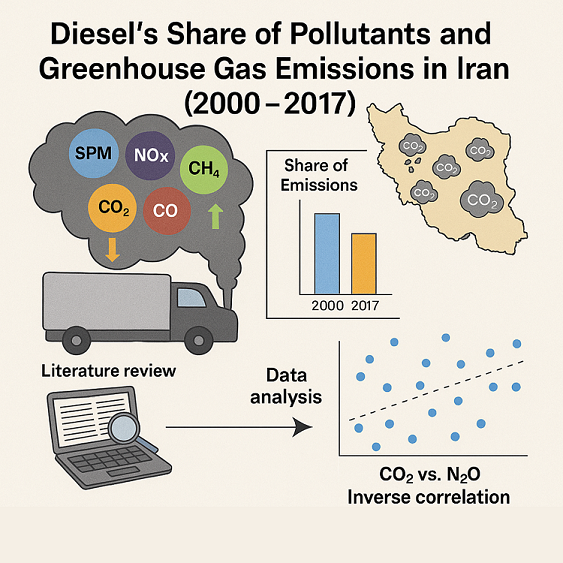
The annual pattern of diesel pollutant emissions is a significant environmental concern, with key pollutants such as suspended particulate matter, nitrous oxide, sulfur trioxide, sulfur dioxide, and nitrogen oxides impacting human health and the environment. A literature review focused on diesel-emitted pollutants was conducted using online databases. Data on diesel-related air pollution in Iran were collected, examining emissions of various pollutants from 2000 to 2017. Data distribution was analyzed using the Kolmogorov-Smirnov test. Descriptive and correlation analyses were performed using SPSS v27 to explore relationships among greenhouse gases and air pollutant emissions. The study examines the impact of diesel on pollutants and greenhouse gas emissions in Iran from 2000 to 2017. It shows a small decline in diesel's share of NOx emissions, attributed to better combustion efficiency and emission control systems. In contrast, diesel's share of SO2 emissions has risen, likely due to increased diesel use despite a shift to natural gas and renewable energy. CO emissions have remained stable due to improved technologies, and CH4 emissions have significantly dropped due to reduced methane slip and bio-based diesel adoption. The study also indicates a decrease in diesel's contribution to SPM, linked to better fuels and particulate filters. The correlation analysis reveals significant inverse relationships between CO2 and N2O emissions and suggests that reducing one type of pollution may affect another.

Graphical Abstract

Diesels Share of Pollutants and Greenhouse Gas Emissions among All Energy Sources in Iran from 2000 to 2017

Keywords

Subjects


OPEN ACCESS

©2026 The author(s). This article is licensed under a Creative Commons Attribution 4.0 International License, which permits use, sharing, adaptation, distribution and reproduction in any medium or format, as long as you give appropriate credit to the original author(s) and the source, provide a link to the Creative Commons license, and indicate if changes were made. The images or other third party material in this article are included in the article’s Creative Commons license, unless indicated otherwise in a credit line to the material. If material is not included in the article’s Creative Commons license and your intended use is not permitted by statutory regulation or exceeds the permitted use, you will need to obtain permission directly from the copyright holder. To view a copy of this license, visit: http://creativecommons.org/licenses/by/4.0/

[1] Song, C., Introduction to chemistry of diesel fuels., Chemistry of Diesel Fuels, 2020, 1-60.
[2] Stanislaus, A., Marafi, A., Rana, M.S., Recent advances in the science and technology of ultra low sulfur diesel (ULSD) production. Catalysis Today, 2010, 153(1-2), 1–68.
[4] Chukwuezie, O.C., Nwakuba, N., Asoegwu, S., Nwaigwe, K., Cetane number effect on engine performance and gas emission: A review. American Journal of Engineering Research, 2017, 6(1), 56–67.
[5] Zevenhoven, R., Beyene, A., The relative contribution of waste heat from power plants to global warming. Energy, 2011, 36(6), 3754–3762
[6] Taylor RI. Fuel-lubricant interactions: critical review of recent work. Lubricants. 2021, 9(9), 92.
[7] Alipour, M., Asadi, H., Chen, C., Besalatpour, A.A., Fate of organic pollutants in sewage sludge during thermal treatments: Elimination of PCBs, PAHs, and PPCPs. Fuel, 2022, 319, 123864.
[8] Sawyer, W.E., Amabie, T., Sylva, L., Nwodo, M.U., Etim, N.G. Polycyclic aromatic hydrocarbons as ambient air pollutants. Air Pollutants in the Context of One Health, 2024, 313–340.
[9] Dembaremba, T.O., Majodina, S., Walmsley, R.S., Ogunlaja, A.S., Tshentu, Z.R., Perspectives on strategies for improving ultra-deep desulfurization of liquid fuels through hydrotreatment: Catalyst improvement and feedstock pre-treatment. Frontiers in Chemistry, 2022, 10, 807225.
[10] Yousefi, R., Mokaramian, S., Study on the production of greenhouse gases in the industrial and power plant sectors of Iran from 1996 to 2017. Journal of Engineering in Industrial Research, 2025, 6(3), 223–243.
[11] Yousefi, R., Mokaramian, S., Statistical study of air pollutant emissions from 1996 to 2017 in domestic, commercial, and public sectors compared to the agricultural sector. Journal of Engineering in Industrial Research, 2024, 5, 171–187.
[12] Murrells, T., Pang, Y., Passant, N., Thistlethwaite, G., Watterson, J., Gilhespy, S., Glendining, M., Gluckman, R., Goodwin, J., Henshall, P., Uk greenhouse gas inventory, 1990 to 2013, Department of Energy and Climate Change (DECC), 2015.
[13] Biswas, S., Verma, V., Schauer, J.J., Sioutas, C., Chemical speciation of PM emissions from heavy-duty diesel vehicles equipped with diesel particulate filter (DPF) and selective catalytic reduction (SCR) retrofits. Atmospheric Environment, 2009, 43(11), 1917–1925.
[14] Stanislaus, A., Marafi, A., Rana, M.S., Recent advances in the science and technology of ultra low sulfur diesel (ULSD) production. Catalysis Today, 2010, 153(1-2), 1–68.
[15] Jyethi, D.S., Air quality: Global and regional emissions of particulate matter, SOx, and NOx. Plant Responses to Air Pollution, 2016, 5–19.
[16] Bala, J., Contribution of SPSS in social sciences research. International Journal of Advanced Research in Computer Science, 2016, 7(6).
[17] Walter, B., Gatellier, B., Near zero NOx emissions and high fuel efficiency diesel engine: The NADITM concept using dual mode combustion. Oil & Gas Science and Technology, 2003, 58(1), 101–114.
[18] Nazari, S., Shahhoseini, O., Sohrabi-Kashani, A., Davari, S., Sahabi, H., Rezaeian, A., SO2 pollution of heavy oil-fired steam power plants in Iran. Energy Policy, 2012, 43, 456–465.
[19] Wagemakers, A., Leermakers, C., Review on the effects of dual-fuel operation, using diesel and gaseous fuels, on emissions and performance. SAE International Journal of Engines, 2012, 2012010869(2012-01-0869), 1–18.
[20] Kohse-Höinghaus, K., Combustion, chemistry, and carbon neutrality. Chemical Reviews, 2023, 123(8), 5139–5219.
[22] Lloyd, A.C., Cackette, T.A., Diesel engines: Environmental impact and control. Journal of the Air & Waste Management Association, 2001, 51(6), 809–847.
[23] Filonchyk, M., Peterson, M.P., Zhang, L., Hurynovich, V., He, Y., Greenhouse gases emissions and global climate change: Examining the influence of CO2, CH4, and N2O. Science of the Total Environment, 2024, 935, 173359.
[25] Knecht, W., Diesel engine development in view of reduced emission standards. Energy, 2008, 33(2), 264–271.
[27] Shahariar, G.H., Sajjad, M., Suara, K.A., Jahirul, M.I., Chu-Van, T., Ristovski, Z., Bodisco, T.A. On-road CO2 and NOx emissions of a diesel vehicle in urban traffic. Transportation Research Part D: Transport and Environment, 2022, 107, 103326.
[28] Ko, A., Kim, J., Choi, K., Myung, C.-L., Kwon, S., Kim, K., Cho, Y.J., Park, S., Experimental study of particle emission characteristics of a heavy-duty diesel engine and effects of after-treatment systems: Selective catalytic reduction, diesel particulate filter, and diesel particulate and NOx reduction. Proceedings of the Institution of Mechanical Engineers, Part D: Journal of Automobile Engineering, 2012,226(12), 1689-1696.
[29] Costoya, X., deCastro, M., Carvalho, D., Arguilé-Pérez, B., Gómez-Gesteira, M., Combining offshore wind and solar photovoltaic energy to stabilize energy supply under climate change scenarios: A case study on the western Iberian Peninsula. Renewable and Sustainable Energy Reviews, 2022, 157, 112037.
[30] Becker, K., Lörzer, Kurtenbach, R., Wiesen, P., Jensen, T., Wallington, T., Nitrous oxide (N2O) emissions from vehicles. Environmental Science & Technology, 1999, 33(22), 4134–4139.
[31] Sayed, S., Massoud, A., Minimum transmission power loss in multi-terminal HVDC systems: A general methodology for radial and mesh networks. Alexandria Engineering Journal, 2019, 58(1), 115–125.
[32] Jiang, J., Chen, L., Sun, Q., Sang, M., Huang, Y., Application of herbicides is likely to reduce greenhouse gas (N2O and CH4) emissions from rice–wheat cropping systems. Atmospheric Environment, 2015, 107, 62–69.
[33] Yousefian, F., Afzali Borujeni, Z., Akbarzadeh, F., Mostafaii, G., Temporal trends and meteorological associations of particulate matter and gaseous air pollutants in Tehran, Iran (2017–2021). Atmosphere, 2025, 16(6), 683.
[34] Jyethi, D.S.,  Air quality: Global and regional emissions of particulate matter, SOx, and NOx. Plant responses to air pollution, 2016, 5–19.
[35] Jamali, Q.B., Bhatti, M.T., Qazi, Q.A., Kaurejo, B.H., Qazi, I.A., Solangi, S.H., Jamali, A.S., Analysis of CO2, CO, NO, NO2, and PM particulates of a diesel engine exhaust. Engineering, Technology & Applied Science Research, 2019, 9(6), 4912–4916.
Volume 7, Issue 1
Winter 2026
Pages 16-28

  • Receive Date 16 July 2025
  • Revise Date 19 August 2025
  • Accept Date 29 August 2025